Gas Power Washer Hose Length and Spray Reach
Unlocking the full cleaning power of your gas power washer involves understanding the critical relationship between hose length and spray reach. This guide will help you decipher how different hose lengths impact your cleaning efficiency, from reaching distant areas to maintaining optimal pressure. We’ll provide step-by-step advice on selecting the correct hose length and offer practical tips for maximizing your power washer’s spray reach for any job.
Gas Power Washer Hose Length and Spray Reach: A Comprehensive Guide
A gas power washer is a fantastic tool for tackling tough cleaning jobs around your home, from stubborn grime on driveways to built-up dirt on siding. But to truly harness its power, you need to understand the intricate relationship between its gas power washer hose length and its spray reach. Many homeowners overlook this crucial aspect, leading to frustration and less-than-ideal cleaning results. This guide will walk you through everything you need to know, from why hose length matters to how to choose the perfect length and maximize your cleaning power.
Key Takeaways
- Understanding the Trade-off: Longer hoses can offer greater reach but may reduce pressure if not chosen carefully, while shorter hoses provide more consistent pressure but limit accessibility.
- Standard Hose Lengths: Most gas power washers come with 25-foot hoses, which are suitable for many common tasks, but longer options are readily available.
- Pressure Loss with Length: Water pressure (PSI) naturally decreases as it travels through a longer hose due to friction.
- Hose Diameter Matters: Thicker diameter hoses experience less pressure loss over distance than thinner ones, even with the same length.
- Choosing the Right Length: Assess your typical cleaning jobs and the distance you need to cover to determine the optimal hose length for your needs.
- Enhancing Spray Reach: Beyond hose length, factors like nozzle selection, water source flow rate, and the power washer’s PSI contribute significantly to spray reach.
Why Hose Length Matters for Your Gas Power Washer
The hose connecting your gas power washer to the spray gun isn’t just a conduit for water; it’s a critical component that directly influences how effectively you can clean and how far you can reach. The length of this hose plays a significant role in two primary areas: the overall accessibility to your cleaning area and the water pressure delivered to the nozzle.
Imagine trying to clean a large driveway with a hose that’s too short. You’ll constantly be moving the power washer, which is cumbersome and time-consuming. On the other hand, a hose that’s too long can lead to a noticeable drop in pressure, making it harder to blast away dirt and debris. Understanding these dynamics is the first step towards achieving optimal cleaning performance with your gas power washer hose length and spray reach.
The Science Behind Pressure Loss in Hoses
It might seem counterintuitive, but water pressure doesn’t magically remain constant as it travels through a hose. Several factors contribute to pressure loss, and hose length is a primary one. This phenomenon is mainly due to:
Visual guide about Gas Power Washer Hose Length and Spray Reach
Image source: m.media-amazon.com
- Friction: As water flows through the hose, it rubs against the inner walls. The longer the hose, the more surface area the water encounters, leading to increased friction and a reduction in pressure.
- Hose Diameter: A narrower hose will experience more friction than a wider hose of the same length because the water is more constricted. This is why hose diameter is as important as length when considering pressure loss.
- Flow Rate: The amount of water flowing through the hose (gallons per minute or GPM) also affects pressure. Higher flow rates can sometimes exacerbate pressure loss over longer distances.
For your gas power washer hose length and spray reach, this means that a 50-foot hose will deliver less pressure at the nozzle than a 25-foot hose, assuming all other factors are equal. This is a crucial point to consider when choosing the right setup for your needs.
Standard Hose Lengths and What They Mean
Most gas power washers typically come with a hose that’s 25 feet long. This length is often considered a good starting point for a variety of common tasks. A 25-foot hose offers a decent balance:
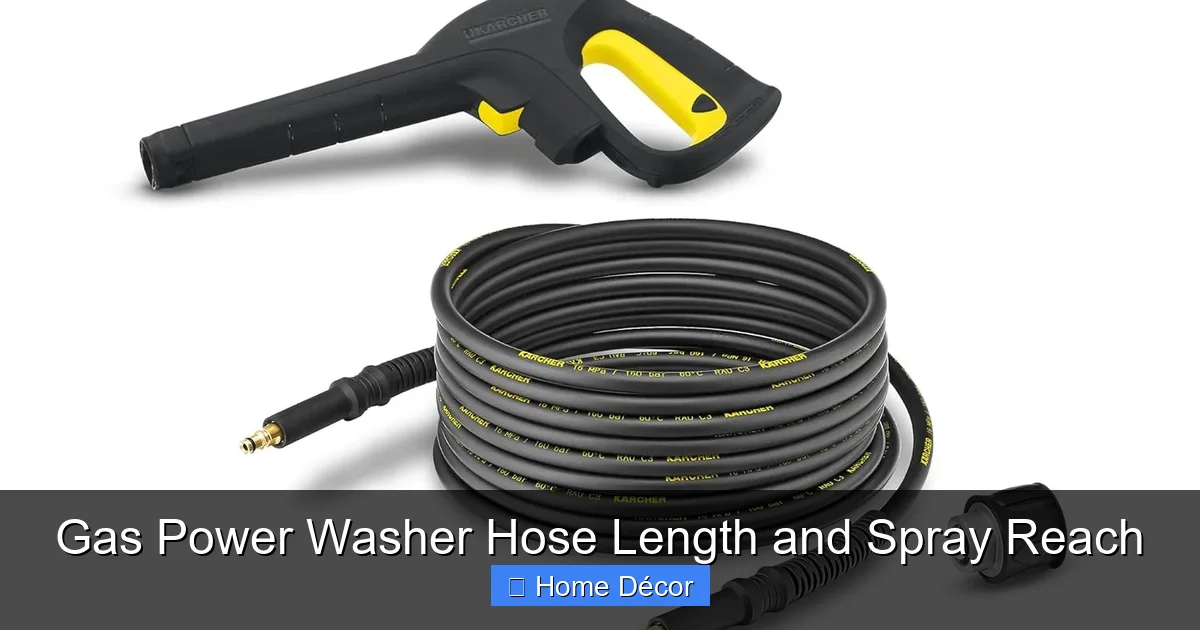
Visual guide about Gas Power Washer Hose Length and Spray Reach
Image source: images-na.ssl-images-amazon.com
- Good Pressure: It’s short enough to minimize significant pressure loss, ensuring you get a strong, effective spray.
- Moderate Reach: It allows you to reach a reasonable distance from the power washer, making it suitable for cleaning patios, smaller driveways, and decks.
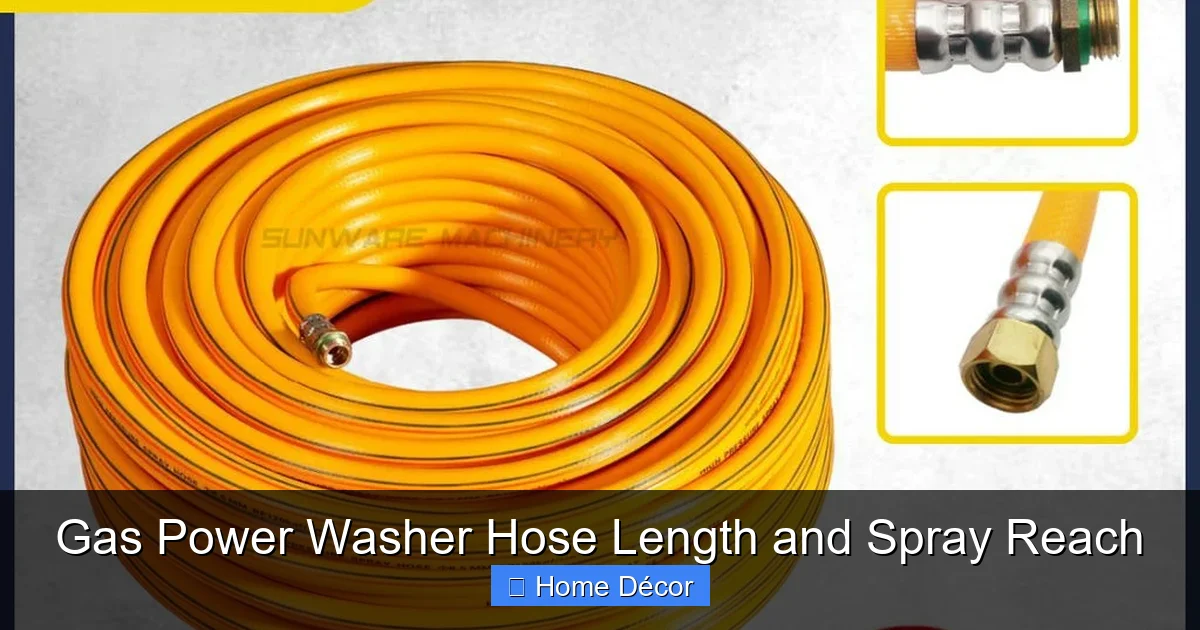
However, for larger properties or more challenging cleaning jobs, a 25-foot hose might feel restrictive. Many manufacturers and aftermarket suppliers offer longer hoses, typically ranging from 35 feet to 100 feet or even more. These longer hoses are designed to provide greater flexibility and reach, but you must be mindful of the potential pressure drop.
How to Determine the Ideal Gas Power Washer Hose Length for Your Needs
Choosing the right gas power washer hose length and spray reach isn’t a one-size-fits-all decision. It depends entirely on your specific cleaning requirements. Here’s a step-by-step approach to help you make the best choice:
Step 1: Assess Your Cleaning Zone
Before you even think about buying a new hose, take a walk around your property and identify the areas you’ll most frequently clean. Consider:
- The size of your driveway and walkways.
- The length of your house’s siding.
- The dimensions of your deck or patio.
- Any remote areas you might need to clean, like fences or garden sheds.
Measure the distances from where you’ll likely be setting up your power washer to the furthest points you’ll need to clean. Add a little extra length for maneuverability; you don’t want to be stretching the hose taut.
Step 2: Consider Your Power Washer’s PSI and GPM
Your power washer’s specifications, particularly its PSI (pounds per square inch) and GPM (gallons per minute), are critical. A higher PSI means more cleaning force, and a higher GPM means more water flow. A powerful machine can often overcome some of the pressure loss associated with a longer hose.
Example: If you have a very powerful 3000 PSI power washer, it might handle a 50-foot hose with less noticeable pressure drop than a 2000 PSI model. Always check your power washer’s manual for recommendations regarding hose length and diameter.
Step 3: Evaluate the Hose Diameter
As mentioned earlier, hose diameter is crucial. Power washer hoses are typically measured in inches, with common sizes being 1/4 inch, 5/16 inch, 3/8 inch, and 1/2 inch.
- 1/4 inch and 5/16 inch: These are generally found on smaller, lower-PSI electric power washers or as whips for reaching tight spots. They experience significant pressure loss over even moderate lengths.
- 3/8 inch: This is the most common and versatile size for gas power washers. It offers a good balance between flexibility and minimizing pressure loss. Most aftermarket hoses for gas models are 3/8 inch.
- 1/2 inch: These are professional-grade hoses designed for high-flow, high-PSI machines. They offer the least pressure loss over distance but are also thicker, heavier, and less flexible.
For most homeowners with gas power washers, a 3/8-inch diameter hose is the sweet spot. If you’re buying a longer hose (50 feet or more), consider opting for a slightly thicker diameter if your power washer can handle it and if it fits your existing fittings. Always ensure the fittings on your new hose match your power washer and spray gun.
Step 4: Factor in Hose Material and Construction
Not all hoses are created equal. The material and construction can affect their durability and how they interact with water pressure.
- Rubber: Often more flexible and durable, but can be heavier.
- PVC: Generally more affordable and lighter, but can become brittle in cold weather.
- Reinforced hoses: Look for hoses with internal braiding (often steel or nylon) for added strength and kink resistance. This is especially important for longer hoses and higher pressures.
A kink-resistant hose is essential for maintaining consistent water flow and preventing pressure fluctuations. For extended gas power washer hose length and spray reach, investing in a high-quality, reinforced hose is highly recommended.
Maximizing Your Gas Power Washer’s Spray Reach
While hose length is a primary factor, it’s not the only determinant of your power washer’s spray reach. Here are other important considerations and tips:
1. The Importance of Nozzle Selection
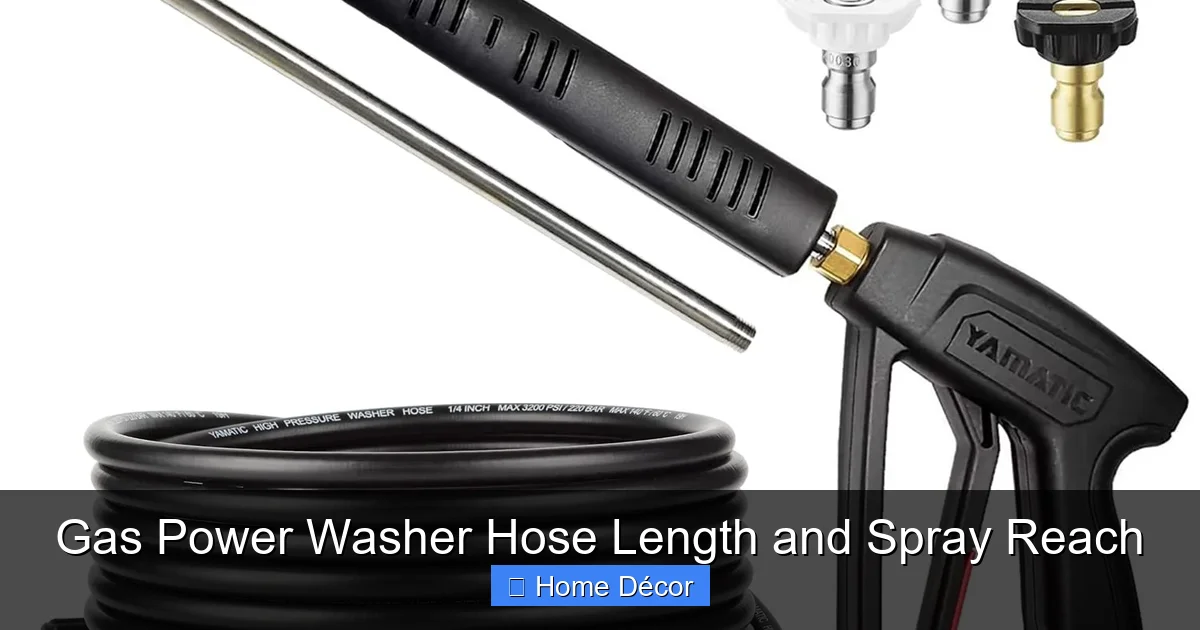
Your power washer’s nozzle is what shapes and directs the water stream. Different nozzles are designed for different tasks and affect both the spray pattern and the distance the water can travel effectively.
- 0-degree (Red) Nozzle: Delivers a concentrated, pencil-like jet. This offers the longest reach but is extremely powerful and can damage surfaces if used improperly.
- 15-degree (Yellow) Nozzle: A wider fan pattern than the 0-degree, offering a good balance of power and coverage.
- 25-degree (Green) Nozzle: A broader fan for general cleaning of medium-sized areas.
- 40-degree (White) Nozzle: The widest fan pattern, ideal for rinsing surfaces or cleaning delicate materials. It offers the least reach.
- Soap (Black) Nozzle: Designed for applying detergent, it has a low-pressure, wide-angle spray with minimal reach.
Tip: For maximum spray reach with your gas power washer hose length, start with a narrower angle nozzle (like 15 or 25 degrees) and gradually move to wider angles as needed for coverage. Always ensure the nozzle is appropriate for the surface you are cleaning.
2. Water Source Flow Rate (GPM)
The amount of water available from your garden hose and spigot is critical. Your power washer can only output as much water as your supply can deliver. If your spigot’s flow rate is too low, it can starve the pump, leading to reduced pressure and spray reach, even with a short hose.
Tip: You can test your spigot’s GPM by timing how long it takes to fill a 5-gallon bucket. If it takes longer than about 30 seconds, you might have a flow rate issue that could be limiting your power washer’s performance.
3. Maintaining Your Power Washer
A well-maintained power washer will always perform better. Ensure your engine is running smoothly, the pump is in good condition, and there are no blockages in the wand or spray gun.
4. Using a Turbo/Whirlaway Nozzle
These specialized nozzles rotate at high speeds, creating a cone of spray that cleans a wider area than a standard nozzle while often maintaining good pressure. They can be very effective for cleaning large, flat surfaces like driveways and patios and can contribute to your overall spray reach.
Troubleshooting Common Hose Issues
Even with the right setup, you might encounter some common problems related to your gas power washer hose.
Problem: Reduced Pressure at the Spray Gun
- Possible Causes: Hose is too long or too narrow; kinks in the hose; clogged nozzle; low water supply GPM; internal hose damage.
- Solutions: Try a shorter hose or a wider diameter hose; ensure the hose is completely unkinked; clean or replace the nozzle; check your water source GPM; inspect the hose for internal damage or leaks.
Problem: Hose Kinking Frequently
- Possible Causes: Cheaply made hose; hose is too stiff; not enough slack when operating.
- Solutions: Invest in a higher-quality, kink-resistant hose; allow for ample slack and avoid sharp bends; coil the hose properly after use.
Problem: Leaks at Hose Connections
- Possible Causes: Worn-out washers; loose fittings; damaged threads.
- Solutions: Replace the rubber washer at the connection point; tighten the fittings securely (but don’t overtighten); inspect the threads for damage and replace the hose or fitting if necessary.
Conclusion
Understanding the interplay between your gas power washer hose length and its spray reach is fundamental to achieving efficient and effective cleaning. By carefully considering your cleaning needs, your power washer’s specifications, and the characteristics of different hoses, you can select the ideal setup. Remember that longer hoses offer more reach but can sacrifice pressure, while shorter hoses maintain pressure but limit accessibility. Don’t forget that nozzle selection, water supply, and proper maintenance also play vital roles in maximizing your power washer’s performance.
Invest in a quality hose that matches your power washer’s capabilities and your property’s demands. With the right knowledge and the correct equipment, your gas power washer will become an even more invaluable tool for keeping your home looking its best.